
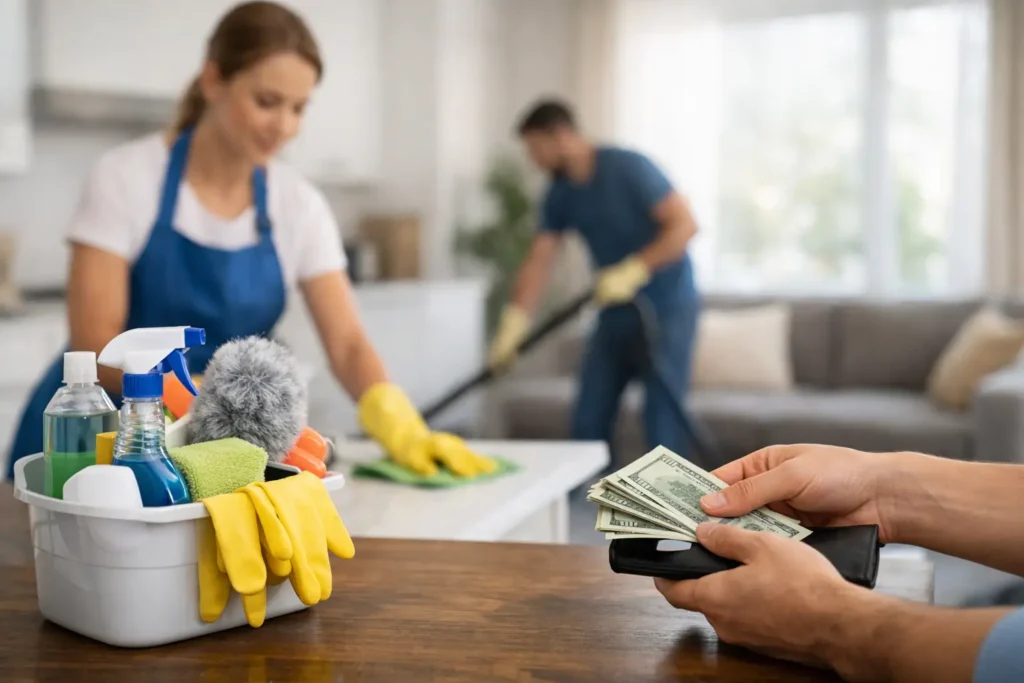
If you have ever gotten two very different quotes for the same house, you have probably wondered what is the going rate for residential cleaning and why the numbers can vary so much. That is a fair question, and the honest answer is that cleaning prices depend on the home, the level of service, and how often you want it done. A quick tidy on a regular schedule will not cost the same as a first-time deep clean or a move-out service where everything has to be scrubbed in detail.
For most homeowners and renters, the better question is not just what the average rate is. It is what you are actually getting for that rate. A lower quote can look good at first, but if it leaves out bathrooms, baseboards, inside appliances, or detailed kitchen work, it may not be a better value. Clear scope matters just as much as the price.
What is the going rate for residential cleaning?
In many US markets, residential cleaning is commonly priced either by the hour or by the job. For a standard cleaning, many companies charge somewhere around $100 to $250 for an average-sized home, while larger homes or homes needing more attention can run higher. Hourly rates often fall in the range of about $25 to $60 per cleaner, depending on the market, the company, and the type of cleaning requested.
That said, averages only go so far. A small apartment cleaned every two weeks may cost far less than a large family home with pets, multiple bathrooms, and months of buildup. Deep cleaning, move-in cleaning, and move-out cleaning usually cost more than recurring maintenance because they take longer and require more detailed work.
If a company gives you an estimate without asking about square footage, bathrooms, condition, pets, or service frequency, that estimate may be too generic to trust. Good pricing is usually based on real details, not a rough guess.
Why cleaning prices vary so much
The biggest reason cleaning rates vary is labor time. Cleaning companies are pricing the amount of work involved, not just the address. A two-bedroom home with one adult occupant is different from a two-bedroom home with kids, dogs, toys, dishes, laundry, and heavy bathroom use.
Home size is one factor, but it is not the only one. The condition of the home matters just as much. A standard recurring clean is usually meant to maintain a home that is already in decent shape. A deep clean is often used when the home has not been professionally cleaned in a while or needs extra detail work in kitchens, bathrooms, corners, and high-touch surfaces.
Bathrooms and kitchens also drive price. These rooms take the most time because they require sanitizing, scrubbing, wiping buildup, and working around more surfaces and fixtures. A home with three bathrooms will usually cost more than a home with one, even if the square footage is similar.
Pets can affect the estimate too. Pet hair on floors, furniture, and baseboards adds time. The same goes for specialty requests like inside the oven, inside the refrigerator, interior windows, blinds, or changing linens.
Standard cleaning vs. deep cleaning vs. move-out cleaning
One of the main reasons people get confused about price is that not all cleaning services are the same.
A standard cleaning is usually the maintenance option. It often includes dusting, vacuuming, mopping, wiping counters, cleaning bathrooms, and straightening up the main living areas. This works well for recurring service because the home is being kept up on a regular basis.
A deep cleaning goes further. It may include heavier bathroom buildup, more detailed kitchen cleaning, baseboards, doors, reachable vents, window sills, and extra hand-wiping in areas that do not always get attention during routine visits. The first cleaning at a home is often priced like a deep clean because it takes more effort to get the space to a maintainable baseline.
Move-in and move-out cleaning is its own category. These cleanings are usually more detailed because the goal is to prepare a property for the next occupant or leave it in strong condition. That can mean cleaning inside cabinets, inside drawers, inside appliances, and areas that are easier to reach once the space is empty. Because the expectations are higher, the price often is too.
How companies usually price residential cleaning
Some companies charge by the hour. That model can work well when the scope is uncertain or the customer has a flexible priority list. The downside is that the final price may be harder to predict if the home takes longer than expected.
Other companies charge a flat rate. Many homeowners prefer this because it gives them a clear number upfront. Flat-rate pricing also encourages a stronger focus on the full job rather than the clock. The catch is that flat rates only work well when the scope is clearly defined.
That is why transparent estimates matter. If a company lists what is included in a standard clean, deep clean, or move-related clean, you can compare quotes more fairly. Without that detail, one estimate may cover far less work than another.
What should be included in the price?
A fair residential cleaning quote should tell you more than the total. It should explain what tasks are included and what counts as an add-on.
For a typical standard cleaning, you should expect core tasks in kitchens, bathrooms, bedrooms, and common areas. That often means wiping surfaces, cleaning sinks and toilets, vacuuming floors and rugs, mopping hard floors, dusting reachable surfaces, and removing trash. In kitchens, it may include wiping exterior appliance surfaces, counters, and cabinet fronts. In bathrooms, it should include mirrors, sinks, toilets, tubs, and showers.
Deep cleaning should go beyond surface upkeep. If a quote says deep cleaning, it should reflect extra detail work, not just the same checklist at a higher price. Move-related cleaning should also be spelled out clearly, especially if inside cabinets, drawers, ovens, or refrigerators are included.
This is where dependable companies stand out. When the task list is clear, customers know what they are paying for and are less likely to be surprised on service day.
How often service affects the rate
Frequency can make a real difference in price. Weekly service often costs less per visit than monthly service because the home stays in better condition. Biweekly service is one of the most common options because it balances cost and upkeep. Monthly cleaning can still be helpful, but each visit may take more time if more dust, grime, and clutter build up between appointments.
One-time cleanings are often priced higher than recurring service. That is because there is no ongoing schedule to maintain the work, and the first visit usually requires more labor. If you are comparing rates, make sure you are comparing one-time pricing with one-time pricing and recurring pricing with recurring pricing.
How to compare cleaning estimates fairly
The easiest way to compare estimates is to look at three things at once: scope, frequency, and reliability. Price matters, but it should not be the only thing you look at.
Ask what rooms are included, whether supplies are included, whether the quote is for standard or deep cleaning, and whether there are extra charges for pets, interior appliances, or first-time service. Also ask whether the company offers flexible scheduling, clear communication, and a satisfaction guarantee. Those details matter when you are trusting someone with your home.
A cheap quote can cost more later if the work is rushed or incomplete. A slightly higher quote can be the better deal if it includes a thorough checklist, dependable arrival times, and a team that will make it right if something is missed.
So what is a fair price?
A fair price is one that matches the actual work, the condition of the home, and the level of detail you need. For some households, that may mean a modest recurring rate for basic upkeep. For others, especially during a move or after months without professional cleaning, a higher one-time cost makes more sense.
The best estimate is not the lowest or highest one. It is the one that is clear, honest, and built around your space. Companies like All Fresh Cleaning Services earn trust by keeping that process simple: explain the service, define the tasks, offer upfront pricing, and work around the customer’s schedule.
If you are shopping for cleaning help, do not be afraid to ask direct questions. A good company will give you direct answers. When the pricing is transparent and the scope is clear, it becomes much easier to choose a service that fits your home, your schedule, and your budget.